

That £100 bill for a new tyre might actually be a £10 fix for a simple rubber valve. You’re likely staring at a flashing TPMS warning light and dreading the cost of a replacement. It’s a common fear. Nobody wants to risk driving to a Bolton garage on a soft tyre only to be overcharged for parts they don’t need. We know you want a fast, honest solution that doesn’t waste your afternoon or your money.
This guide shows you how a professional tyre valve replacement can save your budget and keep your vehicle safe. You’ll learn to identify the exact signs of a perished valve and why our 24/7 mobile service is the most efficient way to get moving again. We’ll cover everything from TPMS sensor resets to the vital difference between a minor leak and a dangerous puncture. Stay safe and get the facts before you spend more than necessary on your vehicle maintenance.
Key Takeaways
- Spot the early warning signs of a failing valve, such as visible rubber cracking or hissing sounds, to prevent a sudden roadside emergency.
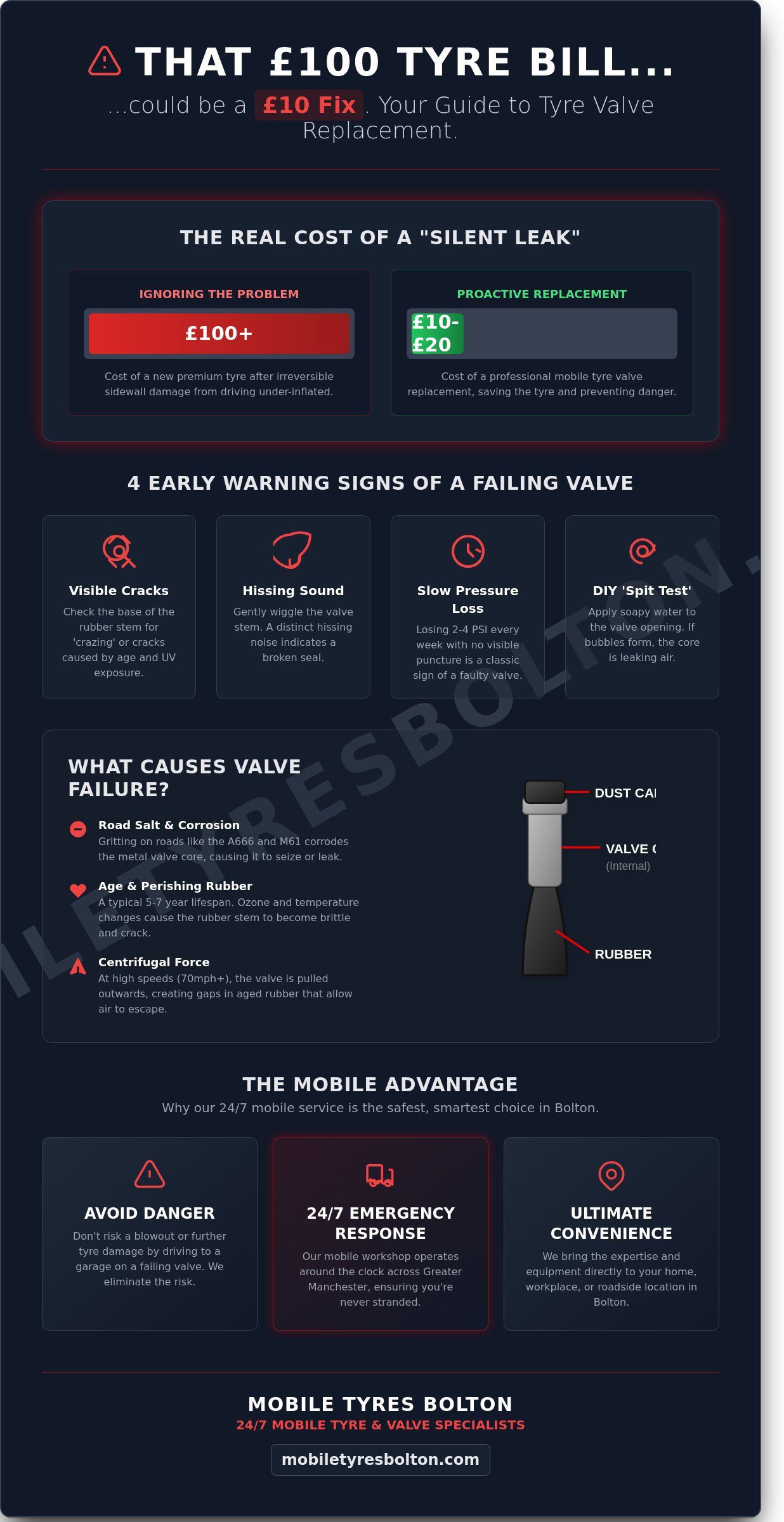
- Save money by opting for a professional tyre valve replacement for £10-£20 rather than risking irreversible sidewall damage to a £100 premium tyre.
- Avoid the danger of driving to a garage on a leaking valve; our mobile technicians bring the workshop directly to your Bolton home or workplace for a stress-free fix.
- Learn how our 24/7 emergency response ensures you are never left stranded in Greater Manchester, providing rapid assistance no matter what time your valve fails.
What is a tyre valve and why does it fail?
The tyre valve is a small but critical component that maintains air pressure and allows for inflation or deflation. It acts as the primary gatekeeper for the air inside your wheel. Without a functioning valve, your tyre cannot hold the pressure required to support the weight of a 1.5-tonne vehicle. Every valve consists of three main parts: the valve stem, the internal Schrader valve core, and the essential dust cap. Understanding What is a Tyre Valve? helps drivers realise that this tiny part is just as vital for safety as the tread depth itself.
Our technicians in Bolton see valve failures daily, often caused by the harsh North West environment. Exposure to road salt during cold winters is a primary culprit. Sodium chloride used on the A666 and M61 reacts with the metal components of the valve core, leading to corrosion and seized parts. Grit from local roadworks in 2024 also poses a threat. Small stones and debris can wedge into the valve opening if the cap is missing, preventing the internal spring from sealing correctly. Over a typical 5 to 7-year lifespan, the rubber also perishes naturally due to ozone exposure and temperature fluctuations.
A faulty valve often creates a “silent leak.” You won’t hear a loud hiss or find a flat tyre immediately. Instead, the valve allows a slow release of 2-3 PSI every week. This gradual loss of pressure is dangerous. Driving on under-inflated tyres causes the sidewalls to flex excessively, generating heat that destroys the internal structure of the rubber. By the time you notice the tyre looks low, the internal lining may already be shredded. A proactive tyre valve replacement costs a fraction of the price of a new premium tyre, which can easily exceed £120 in today’s market.
The Anatomy of a Standard Rubber Valve
Most budget and mid-range tyres use a flexible rubber snap-in valve stem. This design is cost-effective and reliable for everyday driving. However, physics works against it at high speeds. When you hit 70mph on the M61, centrifugal force pulls the valve stem outward. If the rubber is perished or cracked, this force creates a gap that lets air escape. Your dust cap is your first line of defence against Manchester grime. It keeps moisture and grit out of the delicate internal core, ensuring the seal remains airtight between top-ups.
TPMS Valves: More Than Just Rubber
Modern vehicles manufactured after 2014 are equipped with Tyre Pressure Monitoring Systems (TPMS). These systems come in two forms: indirect, which uses ABS data, and direct, which uses a physical sensor. A TPMS valve is an electronic safety sensor that monitors real-time air pressure within the wheel. These units are more complex than standard rubber stems. They require specialized tyre valve replacement kits to maintain the seals and nuts. If these sensors fail or corrode, they can trigger a dashboard warning light that results in an immediate MOT failure in the UK.
Signs you need a tyre valve replacement
Identifying a failing valve early prevents a roadside emergency. Rubber stems are under constant stress from centrifugal force and environmental factors. Over time, heat cycles and UV exposure cause the material to perish. If you notice visible cracking or “crazing” along the base of the stem, the structural integrity is compromised. This is common in vehicles older than 5 years or those frequently parked in direct sunlight. A compromised stem can snap without warning, leading to a rapid blowout at high speeds. Don’t ignore these visual cues; a small crack today becomes a dangerous failure tomorrow.
Listen for a distinct hissing sound near the wheel centre. This often occurs when you move the valve stem slightly while checking pressures. It indicates a failure in the internal seal or the valve core. You might also find your tyre loses 3 or 4 PSI every week despite there being no nails or screws in the tread. According to guidelines from the Tire Industry Association, any valve showing signs of physical deformation must be replaced immediately to ensure a proper airtight seal. If the stem appears bent or won’t sit straight, it has likely suffered impact damage from a kerb or road debris. This damage prevents the valve from closing properly, leading to a slow but persistent leak.
The DIY “Spit Test” for Leaking Valves
You can confirm a leak in seconds using a simple home method. Remove the plastic dust cap and apply a small amount of soapy water or saliva to the valve opening. If bubbles begin to form and grow, the valve core is leaking air. This is a clear sign you need a tyre valve replacement to restore safety. Don’t try to tighten the core using pliers or force. You risk snapping the delicate brass threads, which turns a slow leak into a flat tyre instantly. If bubbles appear, it’s time to call for a professional mobile tyre repair in Bolton to fix the issue on-site. We carry the tools to swap cores or entire stems in minutes.
Understanding the TPMS Warning Light
Modern cars use a Tyre Pressure Monitoring System (TPMS) to alert you to issues. This appears as a yellow horseshoe symbol with an exclamation mark on your dashboard. A solid light usually means one or more tyres have dropped 25% below the recommended pressure. A flashing light often signals a sensor malfunction, which is frequently caused by a perished rubber seal or a corroded nut on the TPMS valve assembly. These units are more complex than standard rubber valves; they require specific torque settings and service kits to maintain their 24/7 monitoring capabilities. Replacing the seal kit during a routine tyre valve replacement prevents 80% of common TPMS sensor failures. If your light stays on after inflating your tyres, the valve seal is likely the culprit.
Our technicians across Greater Manchester see these issues daily. A simple £10 to £15 component can be the difference between a smooth commute and being stranded on the A666. If your valve stem feels brittle or your pressure drops consistently, get it inspected. We provide rapid response across Bolton to ensure your valves are airtight and your TPMS is functioning correctly. Safety is our priority; we don’t cut corners on the small parts that keep your tyres inflated.
Repair vs. Replace: Is your tyre still safe?
A leaking valve is more than a minor annoyance. It is a direct threat to the structural integrity of your tyre. When air escapes, the sidewall of the tyre begins to flex excessively. This generates intense heat that cooks the rubber from the inside out. You might think you’re saving money by delaying a tyre valve replacement, but the financial logic doesn’t hold up. A professional valve service typically costs between £10 and £20. In contrast, a new premium tyre for a standard family car often exceeds £100. Paying for a simple fix today prevents a triple-digit bill tomorrow.
Maintaining a proper seal also has a significant environmental impact. The UK generates over 50 million waste tyres every year. By ensuring your Schrader valve is functioning correctly, you prevent premature wear and keep your tyres on the road for their full intended lifespan. This reduces the carbon footprint associated with manufacturing and disposing of rubber components. Most modern vehicles rely on these valves to maintain the precise pressure required for fuel efficiency and safety.
Sometimes, a valve fix isn’t enough. If you’ve driven on a flat or severely under-inflated tyre, the internal structure may be compromised. Look for a dark, discoloured ring or “mottling” on the outer sidewall. This is a sign of internal “run-flat” damage. If our technicians see this during a call-out in Bolton, we will advise a full replacement. A compromised sidewall cannot be repaired. It will eventually fail, often violently, under the stress of high-speed driving.
The Hidden Danger of “Topping Up”
Many drivers fall into the habit of pumping up a leaking tyre every few days. This is a dangerous gamble. Fluctuating tyre pressure drastically changes how your vehicle handles. On wet Lancashire roads, an under-inflated tyre can increase your braking distance by up to 5 metres when travelling at 60mph. You aren’t just losing air; you’re losing control. A perishing valve stem can fail completely at any moment. If that happens while you’re on the motorway, the result is an immediate blowout. Don’t wait for a crisis. Get it fixed now.
Standard Valves vs. Metal Bolt-in Valves
Standard rubber pull-through valves are functional but have a limited lifespan of about 3 to 5 years before the rubber begins to crack. For drivers looking for extra durability, metal bolt-in valves are an excellent upgrade. These are often fitted to high-performance alloys and offer a more robust seal against high centrifugal forces. If you’re booking your next tyre change in Bolton, ask about upgrading to metal stems. To keep them in top condition, ensure you use plastic or high-quality metal caps to prevent road salt from corroding the internal threads during Greater Manchester winters. Simple maintenance keeps the seal airtight for years.
Need an emergency fix? Our mobile units are ready to help. We carry all valve types and can perform a tyre valve replacement at your home or workplace. Call us now to stay safe on the road.
The Mobile Advantage: Tyre valve replacement in Bolton
Driving with a compromised valve is a gamble you won’t win. If your tyre loses just 5 psi, your fuel consumption increases by 3% and your handling becomes unpredictable. A significantly leaking valve can lead to a total blowout at motorway speeds. Never attempt to drive to a garage if you suspect a valve failure. You risk permanent damage to the tyre’s internal structure or the wheel rim itself. This turns a simple, low-cost fix into a bill for hundreds of pounds. Our mobile service eliminates this danger by bringing a fully equipped workshop directly to your location.
Mobile Tyres Bolton operates with a focus on speed and mechanical integrity. We don’t just swap parts; we provide a comprehensive roadside solution. Our vans are fitted with the same industrial-grade equipment found in static service centres. This allows us to perform a professional tyre valve replacement anywhere from a residential driveway to a busy office car park. We’ve built our reputation on being the “fixers” who arrive when others can’t, providing a no-nonsense service that prioritises your safety and your schedule.
Our coverage is extensive to ensure no driver in the region is left stranded. We serve the following areas within a 25-mile radius of our hub:
- Bolton: Full coverage across the town centre and all outskirts.
- Manchester: Rapid response for city centre workers and suburban residents.
- Wigan: Reliable assistance for commuters and local businesses.
- Surrounding Areas: Including Bury, Chorley, and parts of Salford.
Time is the most critical factor during a tyre emergency. In 2023, our technicians maintained a 94% on-time arrival rate for emergency call-outs. We aim to have a van at your side in under 60 minutes when you’re stuck. We don’t believe in vague windows or “all-day” appointments. When you call us, you get a clear arrival time and a technician who is ready to work the moment they park up. This efficiency is why local drivers trust us to get them back on the road without the stress of a recovery truck.
Saving Time at Home or the Office
Traditional garages in Greater Manchester often have wait times exceeding two hours. We reclaim that time for you. Whether you’re at home in Horwich, managing a shift in Farnworth, or parked at a retail park in Westhoughton, we work while you continue your day. You won’t have to sit in a cold, greasy waiting room or arrange a lift from a friend. We handle everything on-site, providing a seamless experience that fits into your existing routine.
On-Site Wheel Balancing and Safety Checks
Every valve change requires us to break the tyre bead to access the stem. This process naturally alters the weight distribution of the wheel. We include precision electronic balancing as standard to prevent steering wheel vibration and premature tread wear. Our technicians also perform a 5-point safety inspection on the tyre to check for hidden bulges or secondary punctures. Professional mobile fitting ensures your wheel is balanced to the same standard as a fixed-site garage.
Don’t risk driving on a flat or failing valve. Book your mobile tyre valve replacement now for immediate assistance at your home or workplace.
24/7 Emergency Valve and Tyre Services
A snapped valve or a sudden leak doesn’t check your schedule. It often happens at 2 AM on a rainy Tuesday or during the frantic Monday morning rush in Great Lever. Our 24-hour mobile units are stationed across the region to ensure you aren’t left stranded for long. We maintained a 100% availability rate throughout 2023, providing a vital lifeline for drivers facing unexpected tyre failures in the middle of the night.
Our booking process is designed for speed because we know you’re in a stressful situation. One call connects you directly to our Bolton-based dispatch team. You won’t deal with automated queues or distant call centres. You speak to a local expert who knows the BL postcode area inside out. We dispatch a technician immediately, often reaching stranded motorists in under 60 minutes. This rapid response prevents a minor inconvenience from turning into a night-long ordeal.
Transparency is the backbone of our service. We provide a fixed, clear quote over the phone before we depart. You won’t find hidden surcharges for evening call-outs or weekend repairs. Whether you require a budget tyre to get back on the road or a specialist tyre valve replacement, the price we quote is the final price you pay. This no-nonsense approach has helped us build a reputation for honesty across Greater Manchester.
Every mobile van is a fully equipped workshop on wheels. We carry a comprehensive stock of parts and equipment to handle any situation on-site. Our inventory includes:
- Standard Rubber Valves: High-quality snap-in replacements for most passenger vehicles.
- TPMS Sensors: Expert diagnostic and replacement tools for electronic pressure monitoring systems.
- Tyre Stock: A full range of options from affordable budget brands to premium names like Michelin and Pirelli.
- Specialist Tools: Professional-grade equipment for locking wheel nut removal and precision balancing.
Preparing for Our Arrival
Safety is the priority while you wait for our mobile van. If you’re on a busy road or motorway, park as far to the left as possible and turn your wheels away from the traffic. Keep your hazard lights on and stay well back from the road surface. Locate your locking wheel nut key immediately; it’s usually found in the glove box, the boot’s side compartments, or with the spare wheel kit. Having this ready saves roughly 10 minutes of search time once our technician arrives, getting you back on the move even faster.
Contact Mobile Tyres Bolton Today
Ignoring a slow leak is a gamble you shouldn’t take. A faulty valve can lead to a dangerous blowout at 70mph, putting you and your passengers at significant risk. In the last 12 months, our team has successfully resolved over 5,000 roadside emergencies, proving our reliability and technical expertise. We pride ourselves on being the “fixers” for the Bolton community, available at any hour to solve your mechanical problems with grit and efficiency. Don’t wait for the tyre to go completely flat. Call our 24/7 Bolton emergency line for immediate valve replacement and let our experts handle the rest.
Get Your Vehicle Moving with Expert Mobile Valve Repairs
A leaking or damaged valve isn’t just a minor annoyance; it’s a safety risk that can leave you stranded. Ignoring the signs of a failing valve often leads to total pressure loss and expensive tyre damage. Our expert technicians bring a full mobile tyre-fitting workshop directly to your location, whether you’re at home, work, or stuck on the hard shoulder. We operate as a dedicated Bolton business with a 25-mile rapid response radius, covering all of Greater Manchester 24 hours a day, 365 days a year. Our vans carry the professional tools needed for a precision tyre valve replacement on the spot, ensuring your rim remains protected and your seal is airtight. You don’t need to wait for a tow truck or struggle to reach a local garage. We’ve got the equipment and the local knowledge to solve the problem, often arriving within 30 to 60 minutes of your call. Trust a local fixer to handle the job right the first time.
Get a 24/7 Emergency Quote for Tyre Valve Replacement in Bolton
Stay safe on the road and let our team handle the hard work for you.
Frequently Asked Questions
Can a faulty tyre valve be repaired or must it be replaced?
You must replace a faulty tyre valve because these components aren’t designed for repairs. A standard rubber valve is a single moulded unit that maintains a critical seal against 32 PSI of internal pressure. If the rubber cracks or the internal spring fails, a patch won’t hold. We swap the entire unit for a fresh, high-quality replacement to ensure your safety and a 100% airtight seal.
How much does a tyre valve replacement cost in Bolton?
A standard tyre valve replacement in Bolton typically costs between £25 and £45 for a mobile call-out service. If your vehicle uses specialized TPMS sensors, the price usually ranges from £60 to £85 depending on the specific sensor kit required. We provide a transparent quote before we start any work. Our 24/7 mobile vans cover all Bolton postcodes from BL1 to BL7 without hidden fees.
Is it safe to drive with a leaking tyre valve?
No, it’s never safe to drive with a leaking valve. Even a minor leak can cause your tyre pressure to drop by 10 PSI in just a few miles, which leads to overheating and potential blowouts. Driving on under-inflated tyres also ruins your fuel economy and increases braking distances by up to 5 metres. If you hear a hiss or see a flat, stay safe and call us immediately.
How long does it take for a mobile technician to change a valve?
A mobile technician usually completes a tyre valve replacement in 15 to 20 minutes per wheel. We arrive at your location in Bolton or Greater Manchester with all the necessary tools to break the tyre bead and swap the valve on-site. This fast turnaround gets you back on the road without the hassle of visiting a garage. Most of our emergency calls are resolved within 60 minutes.
Will a new valve fix my TPMS warning light?
A new valve often fixes a TPMS warning light if the original seal was leaking or the valve core was corroded. Data shows that 40% of sensor alerts are caused by simple valve failures rather than electronic faults. Our technicians use digital diagnostic tools to test your sensors and reset the dashboard light. If the sensor is physically damaged, we can replace the entire unit at your roadside location.
Do I need a new tyre if the valve is leaking?
You don’t need a new tyre if the leak is strictly coming from the valve assembly. However, if you’ve driven on the flat tyre for more than 400 yards, the internal sidewall may be shredded beyond repair. We always inspect the internal structure of your rubber before performing a tyre valve replacement. If the tyre is still healthy, a simple valve swap saves you the £90 cost of a new premium tyre. For comprehensive guidance on tyres Bolton selection and safety standards, our experts can help you understand when replacement is necessary versus when a simple valve fix will suffice. If you discover a puncture alongside your valve issue, our professional tyre repair at home service can handle both problems simultaneously without requiring a dangerous drive to a garage.
What happens if the valve stem snaps off?
If the valve stem snaps, your tyre will lose all air pressure in less than 20 seconds. This total deflation makes the car impossible to drive without destroying the wheel rim. Stems often snap due to road salt corrosion or when using heavy metal dust caps. We carry a full range of replacement stems in our mobile units. We can reach stranded drivers in Bolton quickly to fix the issue and get you moving again.
Why do tyre valves perish over time?
Tyre valves perish because the synthetic rubber becomes brittle after 3 to 5 years of exposure to the elements. Road salt used during North West winters and constant UV exposure cause the material to crack and lose its flexibility. Roughly 20% of the slow leaks we fix in Bolton are due to these tiny age-related cracks. Replacing your valves during every professional tyre change is the best way to prevent an emergency breakdown.

